Further to my recent review of the latest issue of Rob Imes fanzine Ditkomania, Rob informs me that he has made some copies available via Ebay. He also has a few earlier issues available as well as a trio of old Atlas era comics.
Check out http://www.ebay.com/sch/merchant/rimes12 for more information.
I'll be back Thursday or Friday with the next installment of Fourth World Thursday/Friday.
Wednesday, 4 June 2014

Monday, 2 June 2014
FOURTH WORLD THURSDAY - "BEWARE! PREPARE FOR EVENTS NEW TO ALL YOUR PAST EXPERIENCES!"
And we're back...
The second (published) chapter of the Fourth World saga picks up where the first left off, with Olsen and his new biker gang getting ready to head out on the highway to find the mysterious Mountain Of Judgement.
But first a word from our sponsor. "Beware!
Prepare for events new to all your past experiences! This is the strange assignment upon which Jimmy Olsen and his young friends of
the Newsboy Legion have embarked! Come to the wild area -- the sub-world of bizarre sub-cultures. Like the Outsiders -- who live with a secret -- the awesome deadly secret Jimmy Olsen hopes to ferret out -- Jimmy Olsen must come to grips with The Mountain Of Judgement!"
So runs the first caption on the opening page of this story. As I've said before, Kirby had a real way with words. Sometimes it's just not the right words. "Prepare for events new to all your past experiences!" Huh? What does that even mean?
Oh well, back to the story...
 |
| Superman's Pal Jimmy Olsen #134 cover by Neal Adams |
He doesn't get very far before one of the Outsiders decides enough is enough and tries to run the Kryptonian down with his motorcycle. A rocket powered motorcycle to be sure, but this is Superman we're talking about. Still, it gives another Outsider a chance to grab a convenient bazooka and fire a shell at him. A shell full of Kryponite gas! Hold on just a moment, here! Last issue a Kryponite ray-gun, now shells of K-gas? Did they just stockpile Kryptonite weapons in case of an invasion of Kryptonians? But wait! Our bazooka firing Outsider claims the weapons actually belong to the "Hairies". "And what are the Hairies?" asks Superman.
Time for another session of "Tell It To Auntie"...
Yes, it's one of those awkward exposition scenes. Yango (remember him from last issue? The one that suddenly decided that Jimmy Olsen was his new leader?) explains to Supes that the "Hairies" were the original creators of Habitat, The Wild Area and the Kryptonite weapons. Then one day they just vanished, abandoning everything. He keeps on explaining all of this while beating on Superman, even after the Kryptonian loses consciousness and is being carried off. Who are you REALLY telling, Yango? Superman or the reader? Is this a case of the Fourth World breaking the Fourth Wall?
Anyway, with the Big Blue Boy Scout (and the exposition) out of the way, Olsen, the Newsboys and the Outsiders take to the road in search of the Zoomway, a mysterious road that supposedly leads to The Mountain Of Judgement. The road they're taking appears to be a dead end ending in a rock wall, but acting on his gut instinct, Jimmy guns the Whiz Wagon's motor, aims straight at the cliff face...
...and tears through a fake wall onto a futuristic looking highway. Not any old highway, this is the Zoomway. And it's full of dangerous traps which gradually whittle down the contingent. Loose rocks come flying at them. A giant gap in the road. A water filled tunnel (well, they need something for Flippa Dippa to do). And then, they activate a bizarre psychedelic light show, making it impossible to see the road ahead. Kirby informs us that "Jimmy Olsen and The Newsboy Legion and their Whiz Wagon careening madly through a nightmare of kaleidoscopic form and color!" Quite apart from that caption not quite making sense ("careen" would have better than "careening"), the freaky light show is portrayed by one of Kirby's patented cosmic photo-collages - in black and white(!). Fortunately the Whiz Wagon is equipped with radar, enabling them to stay on the road. By the time they pass through the cosmic mind-trip the Outsiders have all fallen by the wayside leaving just Jimmy and the Newsboys.
Meanwhile, back at the ranch, I mean Habitat, Superman has recovered from his beating earlier in the issue and sets off in hot pursuit of the youngsters. Just in time too, because they have found the Mountain Of Judgement and it's heading straight towards them! Turns out the MOJ is a gigantic (and I do mean gigantic) missile carrier that been disguised as a oriental dragon to terrify intruders.
Supes dives down and pulls the Whiz Wagon out of the path of the MOJ but both are pulled into the maw of the "dragon" by a powerful magnetic force. No sooner are they inside, then a group of hippies, the mysterious "Hairies", reveal themselves and start searching the Whiz Wagon for... a bomb! Which they finally find hidden inside the vehicle's TV camera. Aha! So that was Morgan Edge's ulterior motive all along. Use Olsen and Co. to find the "Hairies" and blow them up! Good job Superman's tagged along, as he takes the brunt of the explosion, leaving everybody unharmed! Jude, the elected leader of the "Hairies" thanks the superhero, saying "You know our story! We seek only to be left alone - to use our talents to develop fully!"
To which Superman tellingly replies "Yes I've been let in on your top secret file!"
Uh, Superman? Just a few pages back you DIDN'T know about them! You had to ask the Outsiders about them, remember? Or was that just to goad Yango into giving the readers a bit of exposition?
And who are the mysterious unseen enemies of the "Hairies"? Morgan Edge and his cronies in Intergang, obviously. But wait! There's a last minute reveal. Old Morgan has a boss, and he is NOT happy. He's also not human! He is in fact, as we'll soon find out, a god. And not a good god, either! His name is Darkseid and he is destined to become one of the major villains of the DC universe. And his first appearance? ONE minor panel in an issue of Superman's Pal, Jimmy Olsen. How ignoble a beginning!
Still, more hints of Kirby's great cosmic epic to come and another of the major players is now on the board. Maybe we won't find out much about Darkseid for a while, but when we do...
Oh, and it's pronounced Dark-SIDE, not Dark-SEED in case you were wondering.
Next time on Fourth World Thursday - things get even weirder!
See you soon!
Yes, it's one of those awkward exposition scenes. Yango (remember him from last issue? The one that suddenly decided that Jimmy Olsen was his new leader?) explains to Supes that the "Hairies" were the original creators of Habitat, The Wild Area and the Kryptonite weapons. Then one day they just vanished, abandoning everything. He keeps on explaining all of this while beating on Superman, even after the Kryptonian loses consciousness and is being carried off. Who are you REALLY telling, Yango? Superman or the reader? Is this a case of the Fourth World breaking the Fourth Wall?
Anyway, with the Big Blue Boy Scout (and the exposition) out of the way, Olsen, the Newsboys and the Outsiders take to the road in search of the Zoomway, a mysterious road that supposedly leads to The Mountain Of Judgement. The road they're taking appears to be a dead end ending in a rock wall, but acting on his gut instinct, Jimmy guns the Whiz Wagon's motor, aims straight at the cliff face...
 |
| A nightmare of kaleidoscopic form and..er black & white |
Meanwhile, back at the ranch, I mean Habitat, Superman has recovered from his beating earlier in the issue and sets off in hot pursuit of the youngsters. Just in time too, because they have found the Mountain Of Judgement and it's heading straight towards them! Turns out the MOJ is a gigantic (and I do mean gigantic) missile carrier that been disguised as a oriental dragon to terrify intruders.
 | |
| The Mountain Of Judgement revealed! |
To which Superman tellingly replies "Yes I've been let in on your top secret file!"
Uh, Superman? Just a few pages back you DIDN'T know about them! You had to ask the Outsiders about them, remember? Or was that just to goad Yango into giving the readers a bit of exposition?
 |
| Darkseid's 1st appearance. In one panel of an issue of Jimmy Olsen. |
Still, more hints of Kirby's great cosmic epic to come and another of the major players is now on the board. Maybe we won't find out much about Darkseid for a while, but when we do...
Oh, and it's pronounced Dark-SIDE, not Dark-SEED in case you were wondering.
Next time on Fourth World Thursday - things get even weirder!
See you soon!
Thursday, 29 May 2014
FOURTH WORLD THURSDAY - "GO! GO! GO! VUDU! DEATH IS FAST! DEATH IS LOUD! DEATH IS FINAL!"
"KIRBY IS HERE!" announced the cover of "Superman's Pal Jimmy Olsen" #133, or as the logo proclaimed "Superman's Ex-Pal the New Jimmy Olsen". And so it begins...
Jack Kirby made his DC debut in August 1970. The story goes that Kirby had boasted that he could take the worst
selling title of the DC line and make it a best-seller. Well, why let the truth get in the way of a good story? What actually happened was that Kirby asked to be assigned to a title that
had no regular creative team so not to put anybody out of a job. The
title he got? “Superman's Pal, Jimmy Olsen”.
 |
| Kirby's cover to Superman's Pal Jimmy Olsen #133 |
Incidentally, although this was Kirby's first published work since his return to DC, it wasn't the first written or drawn. That honour belongs to the first issue of "The Forever People", which we'll come to in due course. Anyway, back to Jimmy Olsen.
Morgan Edge sends our favourite cub reporter to meet up with the sons of the 1940s kid-gang-come-crimefighters “The Newsboy Legion”.
Morgan Edge sends our favourite cub reporter to meet up with the sons of the 1940s kid-gang-come-crimefighters “The Newsboy Legion”.
Who? Well, the original Newsboy Legion had had their own
feature (initially written and illustrated by Kirby and his partner Joe Simon) in the
pages of “Star-Spangled Comics” in the 1940s. The foursome,
Scrapper (who liked a good fight), Gabby (who talked a LOT), Big
Words (who used a lot of... well, you figure it out) and Tommy
(who... er, was called Tommy) were orphans who lived in the aptly
named Suicide Slum, scraping a living by selling newspapers (and occasionally acting as kid reporters). After
one scrape too many with the law, the lads were threatened with
reform school, until kindly local cop Jim Harper took them under his
wing and became their legal guardian. Shortly afterwards Harper ran
afoul of some hoodlums and was beaten to a pulp. When he recovered, Harper went after the thugs, in the guise of a costumed superhero called...
The Guardian. With help from the Newsboys, The Guardian brought the
criminals to justice. But although the Newsboys suspected that their
guardian was in fact THE Guardian, they could never prove it.
Anyway, thirty years later, a new Newsboy Legion
consisting of Scrapper Jr., Gabby Jr., Big Words Jr. and Tommy Jr.
are the reason that Edge sends Olsen to Suicide Slum. Oh, and the
Legion has also gained a fifth member. The original Legion were four
white kids. Kirby obviously decided to mix it up a little by adding a lad of Afro-American origin, the scuba diving Flippa Dippa (or, occasionally, Flipper
Dipper). Good job his dad wasn't around in the forties. Flippa
Dippa Junior would have been a bit of a mouthful. Bizarrely, even
his father calls him Flipper Dipper (or is it Flippa Dippa?). But I digress...
Turns out Big Words has designed an all-purpose vehicle he calls "The Whiz Wagon". The shifty Morgan Edge has financed the construction of this ugly amphibious, flying car in exchange for Olsen and the Newsboys undertaking an assignment for The Daily Planet. The mission is to find a bizarre hippy society (hey it was 1970, after all) in a strange land known only as "The Wild Area". And just where is this strange, lost land? Er... just outside Metropolis. Well, they couldn't have been looking TOO hard for it then, could they?
Now, the dodgy Edge has an ulterior motive for sending Olsen and the Newsboys to search for the Wild Area that becomes apparent an issue or two down the line. For now, we have to take him at his word that the reason he's sending the youngsters is because the Wild Area's inhabitants, the "Hairies", won't trust anybody over the age of thirty. As Edge says to Clark Kent "It's a generation gap type of scene, you know". Now Edge, in his infinite wisdom, decides that Kent and Superman are old friends, and doesn't want Supes involved, so contacts the mysterious crime syndicate "Intergang" to arrange an "accident" for Kent, who is promptly run down as he leaves the Daily Planet. Boy, that didn't take long to organise did it? And surely, knowing Kent is a friend of Superman, the last thing you'd want is the Kryptonian investigating Kent's supposed accident. I don't think you really thought that through Morgan, baby! Of course, Kent survives (being Superman and all) and promptly hides himself away in his apartment to "recuperate". Meaning, of course nobody's going to wonder where Kent is while Superman follows Jimmy to the Wild Area.
So the youngsters arrive in The Wild Area and bump into a couple of biker-types called Iron Mask (hang on, wasn't he an old villain from Kid Colt, Outlaw?) and Vudu. Our pair of Dr. Doom rejects (see left), seem to be impressed by the Whiz Wagon. "I like that set of wheels they're driving, Vudu", says Iron Mask. "When my hand drops - - plow in on them!"
"Your word is law, my commandant", replies Vudu. "The Outsiders take what they want!"
In they charge, with Iron Mask yelling "GO! GO! GO! Vudu! Death is fast! Death is loud! Death is Final!". Man, Kirby had a real way with words didn't he?
One short fight later, Olsen decks Iron Mask with a roundhouse right. Next thing you know, the rest of the Outsiders ride up, take one look at the situation and make Olsen their new chief. "That's our leader you just zonked, hero" says one biker.
"So," says another, who we'll later find out is called Yango, "According to our code - - that makes you our new leader!"
So Superman finally catches up with Jimmy. And Jimmy promptly orders the Outsiders to take him down! Which they do with a handy dandy (and very convenient!) Kryptonite powered ray-gun. Looks like old Morgan Edge was right about that generation gap!
When Supes comes round, Olsen apologises, but tells him that he'll not let anyone stop him get the story he's after. Turns out that The Wild Area, and the bizarre "Habitat" tree-city (a masterpiece of Kirby design that you can see over there on the right) are just minor mysteries. Olsen's real assignment is to find the Mountain Of Judgement (hereafter referred to as the MOJ). What exactly the MOJ is, is unexplained as yet. As Yango says, "Man, you don't grab it! The mountain-- I-it's not like a place! I-it's more like a thing! Like Moby Dick! You go out and meet it - and die!"
At which point the ground trembles. The MOJ is on the move. Jimmy orders the Outsiders to get their motors running. They're off to hunt down the MOJ. And as they're heading out, Olsen warns Superman not to stop them. And that's where this first chapter ends. The Fourth World saga has begun. Not with a bang, but certainly not a whimper either!
Kirby's art is at it's peak here, although DC executives decided that his versions of Superman and Olsen didn't quite meet the DC house style and had many of the figures touched up by Al Plastino. The plot is typical Kirby of the period. It thunders along, maybe not quite making sense at times, with some ideas disposed of in a couple of panels, that writers today would spend a four or six part mini series on. It's crazy, but great entertainment.
Next time on Fourth World Thursday or Friday - things start to get weird!
Now, the dodgy Edge has an ulterior motive for sending Olsen and the Newsboys to search for the Wild Area that becomes apparent an issue or two down the line. For now, we have to take him at his word that the reason he's sending the youngsters is because the Wild Area's inhabitants, the "Hairies", won't trust anybody over the age of thirty. As Edge says to Clark Kent "It's a generation gap type of scene, you know". Now Edge, in his infinite wisdom, decides that Kent and Superman are old friends, and doesn't want Supes involved, so contacts the mysterious crime syndicate "Intergang" to arrange an "accident" for Kent, who is promptly run down as he leaves the Daily Planet. Boy, that didn't take long to organise did it? And surely, knowing Kent is a friend of Superman, the last thing you'd want is the Kryptonian investigating Kent's supposed accident. I don't think you really thought that through Morgan, baby! Of course, Kent survives (being Superman and all) and promptly hides himself away in his apartment to "recuperate". Meaning, of course nobody's going to wonder where Kent is while Superman follows Jimmy to the Wild Area.
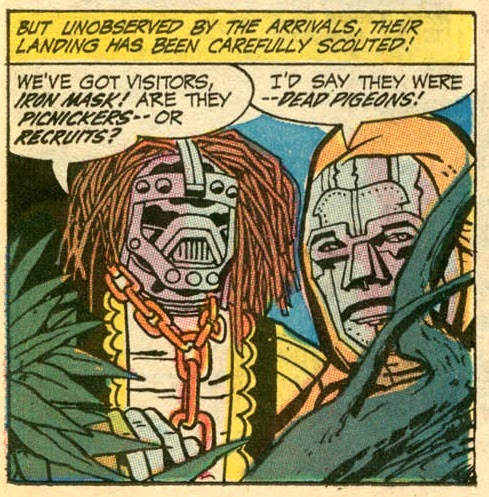 |
| Iron Mask and Vudu - Dr. Doom is consulting his lawyers! |
"Your word is law, my commandant", replies Vudu. "The Outsiders take what they want!"
In they charge, with Iron Mask yelling "GO! GO! GO! Vudu! Death is fast! Death is loud! Death is Final!". Man, Kirby had a real way with words didn't he?
One short fight later, Olsen decks Iron Mask with a roundhouse right. Next thing you know, the rest of the Outsiders ride up, take one look at the situation and make Olsen their new chief. "That's our leader you just zonked, hero" says one biker.
"So," says another, who we'll later find out is called Yango, "According to our code - - that makes you our new leader!"
So Superman finally catches up with Jimmy. And Jimmy promptly orders the Outsiders to take him down! Which they do with a handy dandy (and very convenient!) Kryptonite powered ray-gun. Looks like old Morgan Edge was right about that generation gap!
 | |
| HABITAT - Looks like a cool place to live! |
At which point the ground trembles. The MOJ is on the move. Jimmy orders the Outsiders to get their motors running. They're off to hunt down the MOJ. And as they're heading out, Olsen warns Superman not to stop them. And that's where this first chapter ends. The Fourth World saga has begun. Not with a bang, but certainly not a whimper either!
Kirby's art is at it's peak here, although DC executives decided that his versions of Superman and Olsen didn't quite meet the DC house style and had many of the figures touched up by Al Plastino. The plot is typical Kirby of the period. It thunders along, maybe not quite making sense at times, with some ideas disposed of in a couple of panels, that writers today would spend a four or six part mini series on. It's crazy, but great entertainment.
Next time on Fourth World Thursday or Friday - things start to get weird!
Monday, 26 May 2014
GO, GO, GORGO! AND KONGA! IT'S A NEW DITKOMANIA!

With perfect timing, the latest issue of Rob Imes' Steve Ditko fanzine Ditkomania has just landed on my doormat. Perfect, because Jackie and I saw the new Godzilla movie a few days ago (and, much to my surprise, thoroughly enjoyed it) and this latest issue looks back on Ditko's work on Gorgo (a Godzilla clone) and Konga (a King Kong knock-off) for Charlton in the early 1960s. Behind the gloriously Ditkoesque cover lie reviews of Craig Yoe's recent collections of the two giant monster titles, a lengthy comparison of the Konga movie and the comic book based on it, a look back at the Stan Lee/Gene Colan story "Kunga" from Journey Into Mystery #81 (a knock-off of a knock-off!) and other Ditko-centric articles, including a letters section with readers reactions to the previous issue. A most entertaining read, and I suggest any Ditko fan worth his or her salt should check this issue out. Only 350 numbered copies were printed, so if you're interested I suggest contacting Rob ASAP to see if there are any left. There are contact details, and more about the fanzine at this website - www.unitedfanzineorganization.weebly.com/ditkomania.html
Rob funded this issue through a Kickstarter funding campaign, and the money raised enabled him to really push the boat out with this time. The covers by Jim McPherson and Javier Hernandez (front) and Darren Goodhart (back) are in full colour and very nice they are too. I love the idea of crowdfunding and I hope that Rob, and other fanzine editors, continue to go down this route. One thing I would suggest to anyone using the crowdfunding model though. Please think of your potential backers outside your home country. I could easily pledge towards Ditkomania because Rob had the foresight to realise that he had potential readers outside the US and had options for those people. Much as I would like to pledge towards the new Snyder/Ditko project #20, Kickstarter will not let me as there are no options available for non US backers. Oh well, rant over!
I'll be back soon with more reviews, and another installment of Fourth World Friday.
See you soon,
Steve
Thursday, 22 May 2014
IT'S FOURTH WORLD FRIDAY!!! (A DAY EARLY!)
My favourite of all of the prodigious output by the late Jack "King" Kirby has always been his meisterwork, the so-called "Fourth World" trilogy (technically a tetralogy). I realised the other day that Kirby was 53 when it started publication for DC Comics, the same age I am now.
Jack's departure from Marvel Comics in 1970 to go to their biggest competitor DC shook the industry. It was if John Lennon had left the Beatles to join The Rolling Stones. Kirby had been one of the lynchpins of Marvel the Lennon to Stan Lee's McCartney (maybe with Steve Ditko in the George Harrison role).
It was while at Marvel that Kirby came up with the idea of a major epic storyline detailing a great war between two races of gods, with Earth as the battleground.
It has been suggested that Kirby originally intended to set up his new concept in the pages of Thor. Asgard would fall in Ragnarok, and out of the chaos two worlds would form - one of light, one of darkness.
When he left Marvel, he took his new concepts with him. At DC, he planned to tell his story across three new titles, "The New Gods", "The Forever People" and "Mister Miracle" whilst also taking over the already existing title "Superman's Pal, Jimmy Olsen".
As an aside, Kirby, as always ahead of his time, conceived the notion of serialising the storyline in the comics, later
collecting them in book form. Although a familiar concept in European
(but not British) comics, it was a whole new way of thinking for the American
market. Sadly it never came to fruition. It was another 10-15
years before the idea of the Trade Paperback or Graphic Novel would
develop in the US market. In addition, sales on the new titles didn't
reach expectations and one by one the series were cancelled, leaving the
grand saga unfinished. Kirby continued at DC, creating Kamandi and the
Demon along with other shorter lived series. But back to The Fourth World...
It could be said that each of the four books showed the great conflict from a different perspective. "New Gods" showed the seasoned warriors in action, primarily the god Orion. "The Forever People" showed the eager young recruits, not yet scarred by battle. "Mister Miracle" is the conscientious objector. And "Jimmy Olsen" (and also the non-Kirby "Lois Lane" to a lesser extent) tied the book to the rest of the DC Universe and showed some of the effects of the war on Earth. And it was there in the pages of "Superman's, Pal Jimmy Olsen" that we saw the first seeds of Kirby's magnum opus.
So that's where we will start our issue by issue look at "The Fourth World" next time, with "Superman's Pal, Jimmy Olsen" # 133.
Wednesday, 21 May 2014
IT'S BAAAAAACK!!!!!!!!!!!!!!!!!!!!
After a long gap (is it really three years since I last updated?) Strip Search is about to return. Why so long? It's hard to say, but there have been some contributing factors. Firstly a hard drive crash that took the rest of my Tomb Of Dracula article. Then my full time job left me little time to keep it going. But the main reason, I think, was a growing disillusionment with modern comics. And somehow that spread to comics as a whole. I'm not sure why, but for some reason I just wasn't reading any at all. Now, when this happened it was just after my father's death and everything else just seemed so trivial. That was almost two-and-a-half years ago, and it's only just recently that I've suddenly felt the urge to return to the world of comics. So here I am, back from my exile. Will it last? I hope so. I have come to realise how much I've missed it. So soon, Strip Search will resurface. I will rewrite the rest of that Tomb Of Dracula article, but first up will be the first in a series of articles about Jack Kirby's Klassic "Fourth World" tetraology. Watch out for it Friday, or as it is now known "Fourth World Friday".
See you soon,
Steve
See you soon,
Steve
Sunday, 24 April 2011
BACK FROM THE DEAD... IN MORE WAYS THAN ONE! (PART ONE)
Well, it's been a while again, but I'm finally hoping to get this blog back on a (semi-)regular track.
As befits the returning from the dead theme, today I'm taking a look at Marvel's classic 1970's Tomb Of Dracula, recently collected in a series of three hardcover omnibus collections. Be warned though, this comes with a bit of a history lesson...
Back in the mid-1950s there was a certain amount of hysteria against comic books. The general perception is that the brunt of the anti-comic movement was aimed at the horror comics, especially those published by William Gaines' EC comics, but in truth there were also complaints about the levels of violence in war and crime comics and about the sexual innuendo in what has become known as 'good girl art'.
The anger against the salacious nature of some of these titles actually led to at least two city councils - Houston, Texas and Oklahoma City - passing ordinances prohibiting the sale of crime and horror comics. Another attempt, by the city council of Los Angeles, failed when it was deemed by the courts to be unconstitutional.
 In addition The United States Senate Subcommittee on Juvenile Delinquency, formed in 1953 to investigate the problem of, well, juvenile delinquency, also turned it's attention to the problems of comic books. A defining moment during the subcommittee's public hearings was Bill Gaines attempt to defend his EC comics including this infamous exchange between Gaines and Democrat Senator Estes Kefauver of Tennessee...
Mr. Beaser: Is there any limit you can think of that you would not put in a magazine because you thought a child should not see or read about it?
Gaines: My only limits are the bounds of good taste, what I consider good taste.
Sen. Kefauver [refering to the cover of EC's Crime SuspenStories #22 -pictured]: This seems to be a man with a bloody ax holding a woman's head up which has been severed from her body. Do you think that is in good taste?
Gaines: Yes, sir, I do, for the cover of a horror comic....
Sen. Kefauver: This is the July one [Crime SuspenStories #23]. It seems to be a man with a woman in a boat and he is choking her to death with a crowbar. Is that in good taste?
Gaines: I think so.
The hearings made the front page of the New York Times the next day. The bad press meant that in several publishers were forced to revamp, censor or even cancel many long-running and popular titles.
It was in response to this anti-comics fervour that the Comics Magazine Association of America was formed in September 1954. Headed by Charles F. Murphy, a noted New York attorney, the CMMA established the Comics Code Authority (CCA), which based its code upon an earlier, but largely unenforced code, which had been drafted in 1948 by the Association Of Comics Magazine Publishers. The Comics Code Authority served as a way for the comics industry to censor itself as opposed to the publishers being Federally regulated.
The new code banned the depiction of "policemen, judges, government officials, and respected institutions ... in such a way as to create disrespect for established authority" and "in every instance good shall triumph over evil". Excessive violence was forbidden, as were horror staples such as Zombies, Ghouls, Werewolves and... Vampires (see where we're going here?).
The code stayed in force until 2011, although as time went on many of the restrictions were slowly lifted. On January 28th 1971, the code was revised to allow some leeway in the depiction of criminal behavior. Also newly allowed were "vampires, ghouls and werewolves... when handled in the classic tradition such as Frankenstein, Dracula, and other high calibre literary works written by Edgar Allan Poe, Saki, Conan Doyle, and other respected authors whose works are read in schools around the world". The poor Zombie, however, apparently lacked enough literary merit and thereby remained on the banned list.
Having nearly gone out of business in 1957 after publisher Martin Goodman made a disasterous decision to switch distributors, Marvel Comics had risen through the 1960s to be a main player in the comics field, due in no small part to writer/editor Stan Lee's new take on the superhero formula. In 1969 the Marvel line consisted primarily of superhero titles alongside a handful of Western titles (Kid Colt Outlaw, Rawhide Kid) and Teen humour/romance titles (Millie The Model, Chili). Added to the line were two horror titles - Tower Of Shadows and Chamber Of Darkness which contained new short horror stories, including adaptatons of tales by writers such as H.P. Lovecraft.
Another new title, launched in 1970, was Astonishing Tales. An addition to Marvel's burgeoning superhero line, it was a split book featuring two stories, the first starring Marvel's Tarzan knock-off Ka-Zar, the other featuring frequent Fantastic Four protagonist Dr. Doom. While short-lived, the Dr. Doom strip paved the way for many of Marvel's future horror titles by having the concept of having a villainous figure as the star of a comic book. A format that titles such as Tomb of Dracula and Werewolf by Night would take so much further.
Over in the pages of Marvel's best selling title 'The Amazing Spider-Man' (#101) writers Stan Lee and Roy Thomas introduced Morbius, the so-called 'Living Vampire'. Created by scientific methods rather than supernatural means, Morbius was the first of Marvel's vampire characters. Roy Thomas had originally intended for the protagonist of this story to be Dracula himself, but Lee nixed the idea, probably due to other plans he already had for the character, as can be seen by the announcement made in the Bullpen Bulletins pages in Marvel Comics of July 1971.
"SAVAGE TALES (our M-rated mag - for the mature reader) looks like such a howlin' hit that we're following it up with a ghoulish 50c goodie called THE TOMB OF DRACULA (or THE HOUSE OF DRACULA, we haven't decided yet). It's a wholly new concept, starring Dracula himself, as he is - was - and perhaps will be. With art by GENE COLAN, BERNI WRIGHTSON and GRAY MORROW among others, and a team of the world's most titanic scripters, headed by Marvel's merry masters SMILIN' STAN and RASCALLY ROY themselves! May we modestly say - it ain't to be missed!"
Marvel's original concept of a 50 cent black and white magazine fell by the wayside at the last minute and the Tomb Of Dracula made it's belated debut as a regular colour comic with a cover date of April 1972. Ironically, the delays to the title's launch -partly caused by having to have Gene Colan's art reformatted for the smaller page size of the comic book format - meant that Dracula was actually beaten to the newsstand by another of Marvel's horror creations "Werewolf By Night" which debuted in the pages of Marvel Spotlight #2 with a February 1972 cover date.
The premiere issue of Tomb Of Dracula was scripted by Gerry Conway from a plot by either Stan Lee or Roy Thomas (or possibly both). The cover art was by the legendary Neal Adams, but it was the interior art by the incomparible Gene Colan that gave the title its look. Colan, who had been a stalwart of strips such as Iron Man, Daredevil and had excelled on Doctor Strange, had lobbied to be given the title over Stan Lee's first choice of Sub-Mariner creator Bill Everett. In an interview with Roy Thomas in Alter Ego magazine (Vol. 3, #6) Colan reveals how he got the job...
COLAN: Yep. The only strip I really begged for was Dracula. He promised it to me, but then he changed his mind, he was going to give it to Bill Everett.
COLAN: Oh, I said to him, "Stan, you gave me your word I could have it!" He said, "No, I'm afraid not, Gene. I actually promised it to Bill before you!" But I didn't take that for a answer. I worked up a page of Dracula, long before Bill did anything. I just sat there, and I inked it, a whole page of the character, just sample drawings of him. I fashioned him after Jack Palance, years before Palance played Dracula on TV, and I sent it in. I got an immediate call back. Stan said, "The strip is yours."
Writer Conway only stayed on the title for one more story before passing the reins to Archie Goodwin with the third issue. Goodwin introduces us to Rachel Van Helsing, descendent of Abraham Van Helsing from Bram Stoker's original novel, and her mute servent Taj. The two eventually encounter Drake and the three combine forces to hunt down Dracula.
Goodwin also only lasted two issues before handing it over to Gardner N. Fox. Better known for his superhero works at Marvel's main rival DC, Fox had also written for pulp magazines such as Weird Tales. He too only lasted two issues and with Tomb Of Dracula's seventh issue the writing chores were taken over by Marv Wolfman. And it is with Wolfman's arrival the strip really takes off...
To be continued...
As befits the returning from the dead theme, today I'm taking a look at Marvel's classic 1970's Tomb Of Dracula, recently collected in a series of three hardcover omnibus collections. Be warned though, this comes with a bit of a history lesson...
Back in the mid-1950s there was a certain amount of hysteria against comic books. The general perception is that the brunt of the anti-comic movement was aimed at the horror comics, especially those published by William Gaines' EC comics, but in truth there were also complaints about the levels of violence in war and crime comics and about the sexual innuendo in what has become known as 'good girl art'.
The anger against the salacious nature of some of these titles actually led to at least two city councils - Houston, Texas and Oklahoma City - passing ordinances prohibiting the sale of crime and horror comics. Another attempt, by the city council of Los Angeles, failed when it was deemed by the courts to be unconstitutional.
 In addition The United States Senate Subcommittee on Juvenile Delinquency, formed in 1953 to investigate the problem of, well, juvenile delinquency, also turned it's attention to the problems of comic books. A defining moment during the subcommittee's public hearings was Bill Gaines attempt to defend his EC comics including this infamous exchange between Gaines and Democrat Senator Estes Kefauver of Tennessee...
Mr. Beaser: Is there any limit you can think of that you would not put in a magazine because you thought a child should not see or read about it?
The hearings made the front page of the New York Times the next day. The bad press meant that in several publishers were forced to revamp, censor or even cancel many long-running and popular titles.
It was in response to this anti-comics fervour that the Comics Magazine Association of America was formed in September 1954. Headed by Charles F. Murphy, a noted New York attorney, the CMMA established the Comics Code Authority (CCA), which based its code upon an earlier, but largely unenforced code, which had been drafted in 1948 by the Association Of Comics Magazine Publishers. The Comics Code Authority served as a way for the comics industry to censor itself as opposed to the publishers being Federally regulated.
The new code banned the depiction of "policemen, judges, government officials, and respected institutions ... in such a way as to create disrespect for established authority" and "in every instance good shall triumph over evil". Excessive violence was forbidden, as were horror staples such as Zombies, Ghouls, Werewolves and... Vampires (see where we're going here?).
The code stayed in force until 2011, although as time went on many of the restrictions were slowly lifted. On January 28th 1971, the code was revised to allow some leeway in the depiction of criminal behavior. Also newly allowed were "vampires, ghouls and werewolves... when handled in the classic tradition such as Frankenstein, Dracula, and other high calibre literary works written by Edgar Allan Poe, Saki, Conan Doyle, and other respected authors whose works are read in schools around the world". The poor Zombie, however, apparently lacked enough literary merit and thereby remained on the banned list.
Having nearly gone out of business in 1957 after publisher Martin Goodman made a disasterous decision to switch distributors, Marvel Comics had risen through the 1960s to be a main player in the comics field, due in no small part to writer/editor Stan Lee's new take on the superhero formula. In 1969 the Marvel line consisted primarily of superhero titles alongside a handful of Western titles (Kid Colt Outlaw, Rawhide Kid) and Teen humour/romance titles (Millie The Model, Chili). Added to the line were two horror titles - Tower Of Shadows and Chamber Of Darkness which contained new short horror stories, including adaptatons of tales by writers such as H.P. Lovecraft.
Another new title, launched in 1970, was Astonishing Tales. An addition to Marvel's burgeoning superhero line, it was a split book featuring two stories, the first starring Marvel's Tarzan knock-off Ka-Zar, the other featuring frequent Fantastic Four protagonist Dr. Doom. While short-lived, the Dr. Doom strip paved the way for many of Marvel's future horror titles by having the concept of having a villainous figure as the star of a comic book. A format that titles such as Tomb of Dracula and Werewolf by Night would take so much further.
Over in the pages of Marvel's best selling title 'The Amazing Spider-Man' (#101) writers Stan Lee and Roy Thomas introduced Morbius, the so-called 'Living Vampire'. Created by scientific methods rather than supernatural means, Morbius was the first of Marvel's vampire characters. Roy Thomas had originally intended for the protagonist of this story to be Dracula himself, but Lee nixed the idea, probably due to other plans he already had for the character, as can be seen by the announcement made in the Bullpen Bulletins pages in Marvel Comics of July 1971.
"SAVAGE TALES (our M-rated mag - for the mature reader) looks like such a howlin' hit that we're following it up with a ghoulish 50c goodie called THE TOMB OF DRACULA (or THE HOUSE OF DRACULA, we haven't decided yet). It's a wholly new concept, starring Dracula himself, as he is - was - and perhaps will be. With art by GENE COLAN, BERNI WRIGHTSON and GRAY MORROW among others, and a team of the world's most titanic scripters, headed by Marvel's merry masters SMILIN' STAN and RASCALLY ROY themselves! May we modestly say - it ain't to be missed!"
Marvel's original concept of a 50 cent black and white magazine fell by the wayside at the last minute and the Tomb Of Dracula made it's belated debut as a regular colour comic with a cover date of April 1972. Ironically, the delays to the title's launch -partly caused by having to have Gene Colan's art reformatted for the smaller page size of the comic book format - meant that Dracula was actually beaten to the newsstand by another of Marvel's horror creations "Werewolf By Night" which debuted in the pages of Marvel Spotlight #2 with a February 1972 cover date.
The premiere issue of Tomb Of Dracula was scripted by Gerry Conway from a plot by either Stan Lee or Roy Thomas (or possibly both). The cover art was by the legendary Neal Adams, but it was the interior art by the incomparible Gene Colan that gave the title its look. Colan, who had been a stalwart of strips such as Iron Man, Daredevil and had excelled on Doctor Strange, had lobbied to be given the title over Stan Lee's first choice of Sub-Mariner creator Bill Everett. In an interview with Roy Thomas in Alter Ego magazine (Vol. 3, #6) Colan reveals how he got the job...
COLAN: Yep. The only strip I really begged for was Dracula. He promised it to me, but then he changed his mind, he was going to give it to Bill Everett.
THOMAS: It's funny, I don't remember Bill being the designated artist, but I'm sure you're right.
COLAN: Oh, I said to him, "Stan, you gave me your word I could have it!" He said, "No, I'm afraid not, Gene. I actually promised it to Bill before you!" But I didn't take that for a answer. I worked up a page of Dracula, long before Bill did anything. I just sat there, and I inked it, a whole page of the character, just sample drawings of him. I fashioned him after Jack Palance, years before Palance played Dracula on TV, and I sent it in. I got an immediate call back. Stan said, "The strip is yours."
THOMAS: It probably worked out for the best. Bill was certainly a good artist, but I don't think he'd have gotten what Stan was really looking for in Tomb of Dracula.
COLAN: I didn't think so. I thought I was the only one for it.
Conway's script introduced Frank Drake, last living descendent of the Dracula line. Drake travels to Transylvania with his fiancee Jeanie and friend Clifton Graves with a plan to turn the legendary Castle Dracula, which Frank has inherited, into a tourist attraction. However, things don't quite go as planned when, whilst exploring the castle Graves falls through a rotting floor and finds himself in a crypt, complete with a coffin containing a skeleton with a wooden stake in it's chest area. Graves removes the stake thus causing Dracula to rise from his tomb.COLAN: I didn't think so. I thought I was the only one for it.

Writer Conway only stayed on the title for one more story before passing the reins to Archie Goodwin with the third issue. Goodwin introduces us to Rachel Van Helsing, descendent of Abraham Van Helsing from Bram Stoker's original novel, and her mute servent Taj. The two eventually encounter Drake and the three combine forces to hunt down Dracula.
Goodwin also only lasted two issues before handing it over to Gardner N. Fox. Better known for his superhero works at Marvel's main rival DC, Fox had also written for pulp magazines such as Weird Tales. He too only lasted two issues and with Tomb Of Dracula's seventh issue the writing chores were taken over by Marv Wolfman. And it is with Wolfman's arrival the strip really takes off...
To be continued...
Thursday, 23 September 2010
SECRET AGENT MAN (SLIGHT RETURN)
 Way back in May, I mentioned IDW's Secret Agent Corrigan collection by Archie Goodwin and Al Williamson and promised to review it on it's release in July. Well, July came and went with no sign of the book, but here in September it's finally available and it was certainly worth the wait!
For those of you unfamiliar with this classic strip, here's a bit of background information. Secret Agent X-9 (as the strip was originally titled) started in January 1934. Supplied to newspapers by the King Features Syndicate, the strip was written by Dashiell Hammett, of Maltese Falcon fame, and illustrated by the legendary Alex Raymond, well known for his work on the Tarzan and Flash Gordon comic strips. Despite this impeccable pedigree, Secret Agent X-9 was never a success Hammett soon moved on, followed not longer after by Raymond.
X-9 was originally a nameless agent working for a unnamed agency. In the 1940s X-9 was finally given a name, Phil Corrigan, and the agency was revealed to be the FBI. The strip was a hybrid of a private detective and secret agent adventure, and alternated between the two styles.
After Raymond and Hammett's departure, the strip continued under the hands of Charles Flanders (1937), Mel Graff (1939-1960) and Bob Lubbers (1960-1966) before being handed to the team of writer Archie Goodwin and artist Al Williamson. This team supreme handled the strip from 1967-1980, taking the opportunity to introduce some more fantastical elements into the storylines along the way. In 1980 they passed the baton to veteran EC artist George Evans who wrote and drew the strip for sixteen years. When he retired in 1996, the strip was retired with him.
History lesson over, let's look at the new collection. The first thing that strikes you is the size. I was expecting a volume the same format as IDWs excellent King Aroo collection, but this hardcover is much larger, measuring 10 1/2 inches by 11 1/2 inches. This increase in page size, together with the excellent reproduction straight from Williamson's own proof copies, shows off his luxuriant art in all it's detail.
The volume opens with an introductory piece by Mark Schultz, telling us a little about Al Williamson and his arrival on the strip and how he insisted on bringing Archie Goodwin on board as well. This introduction also includes examples of Williamson's other comic work, including a strip from his and Goodwin's work on Star Wars, a page from his work with EC comics in the 1950s and a page of art from a Flash Gordon comic book also written by Goodwin.
Bruce Canwell brings up the rear with a well written and researched article on Secret Agent X-9/Corrigan's history, illustrated with sample strips from Bob Lubbers, George Evans, Alex Raymond and Mel Graff.
In between there is, of course, the meat of the book. Over 800 daily strips from 30th January 1967 through to 30th August 1969.
Goodwin and Williamson took over Secret Agent X-9 at the height of the spy-mania fad that gripped America in the mid 1960s. TV shows such as The Man (and Girl) From U.N.C.L.E., Get Smart and The Wild, Wild West filled the nations airwaves. James Bond still ruled the silver screen. Comic books weren't exempt from the spy game. Marvel took their war hero Sgt. Fury and brought him into the modern day as Nick Fury, Agent of S.H.I.E.L.D. while DC had King Faraday, and even adapted the Bond story Dr. No into comic form.
Shortly after the Goodwin/Williamson team took over, King Features decided to change the strip's title to Secret Agent Corrigan, a title Williamson in particular wasn't keen on. Goodwin decided to take the strip back to its Hammitt/Raymond roots. Under Bob Lubbers, Corrigan's exploits were light-hearted. The new team brought in a darker, more violent and more cinematic feel to the strip. The team's love for adventure movies shines through in these stories. In later years they would stretch, but never break, the limits of the strips format as they would alternate the spy/detective stories with ever more fantastical stories inspired by movies such as The Lost World. It's a credit to them that these tales seem perfectly natural and the strip never quite "jumps the shark" to use TV parlance.
All that will come in later volumes however. For now, we remain in the hard-boiled detective spy genre. While the stories are certainly of their time, Goodwin's taut plotting and credible dialogue perfectly compliments Williamson's exquisite artwork.
Roll on vol. 2.
I'll be back soon with more reviews.
Until then, take care,
Steve
Sunday, 19 September 2010
A TASTE OF HONEY...
 Moonstone Books have over the years given us many new comic stories featuring classic characters from the worlds of comic strips, pulp magazines and TV. The Green Hornet, The Avenger, Captain Action, Kolchak: The Night Stalker, The Saint, Boston Blackie among many others have all appeared under the Moonstone imprint. Now they have turned their attention to a short-lived 1960s TV show, "Honey West".
Originally created by G.G. Fickling (a psuedonym for husband and wife Forest and Gloria Fickling) in their 1957 novel 'This Girl For Hire', Honey would appear in nine novels between 1957 and 1964, with two more in 1971. In 1965, television producer Aaron Spelling, bought the rights to the character and used her in an episode of Burke's Law, 'Who Killed The Jackpot' which aired in April that year. Played by Anne Francis of Forbidden Planet fame, Honey proved popular and was quickly spun off into her own show. A few changes were made to the format. It was 1965, James Bond was one of the biggest things on the silver screen, and spy shows ruled the TV airwaves. There was The Man From U.N.C.L.E., The Avengers, The Wild Wild West and even Burke's Law suddenly became Amos Burke, Secret Agent. So it was no surprise that Honey and her right hand man Sam Bolt (Johnny Doom in the original books) were private detectives with the latest in secret agent gadgets - lipstick microphones, earrings full of teargas, exploding compacts and, of course, a fully equipped mobile crime lab cleverly disguised as a TV repairman's van. Another addition to the TV show was Honey's pet ocelot, Bruce. Well, every show needs it's gimmick!

It was a fun, light-hearted show though and Anne Francis played Honey West to perfection.
So, how does Moonstone's new comic book stand up? Quite well, actually. The inaugral issue is the first part of a story entitled "Killer On The Keys", written by Trina Robbins and illustrated by Cynthia Martin. Set circa 1967, at the height of the 'flower power' craze, Honey goes undercover as a go-go dancer at the nightclub 'The Purple Pussy' to investigate the murder of a cocktail waitress. Needless to say, it's not a simple case and very soon one of the other dancers at the club is hospitalized after an attempt on Honey's life.
Robbins seems to be trying to strike a balance between the original novels and the TV show. There are no sign as yet of lipstick mikes and exploding compacts, although Bruce the Ocelot is present and correct. There's no sign either of Sam Bolt or his novel counterpart Johnny Doom. Whether or not he/they turn up, we'll have to wait and see. I'll be along for the ride for the foreseeable future, as long as sales support the title.
I'll be back soon, with more Secret Agent stuff.
Until then, take care,
Steve
Saturday, 11 September 2010
KATS, MICE, PUPPS, TIGERS AND OTHER ASSORTED KREATURES

In the long history of the newspaper comic, few strips have been lauded as much as George Herriman's surreal 'Krazy Kat'. Launched in 1913, the strip ran thirty-one years, only ending with Herriman's death in 1944.
The eponymous Kat, along with Ignatz Mouse, Officer Bull Pupp and sundry other anthropomorphic characters existed in the ever changing landscape of Coconino County, a bizarre, almost Daliesque, universe where the backdrops melt and shift around. Unique in both its surreal visuals and bizarre wordplay, the strip was feted by such illuminaries as newspaper publisher William Randolph Hearst, art critic Gilbert Seldes and poet e.e. Cummings. It's even said that Pablo Picasso followed the strip avidly. In later years the strip's influence would be seen in the works of comics artists such as Robert Crumb and Chris Ware.
The main thrust of the strip was the three way relationship between the aforementioned Kat, Mouse and Dog. Krazy is a carefree, almost simple-minded, cat whose gender is ambigious, being referred to both as "he" and "she". He/she loves Ignatz Mouse, however this love is unrequited - in fact Ignatz despises Krazy and continually tries to throw bricks at the feline's head. Krazy however misinterprets these bricks as 'love taps'. Meanwhile Offissa Pupp, Coconino's local police officer, who harbours a crush for Krazy, attempts to thwart Ignatz's plans and incarcerate the mouse in his jailhouse.
Extended narratives were unheard of in 'Krazy Kat' but in 1936, twenty-three years on from it's inception, Herriman started the storyline which has now become known as 'Tiger Tea'. It is that tale that has recently been collected by Craig Yoe as part of his Yoe Books series for IDW Publishing.
'Tiger Tea' starts with the collapse of Katnip Konsolidated, leaving Coconino County's wealthiest citizen Mr. Meeyowl pennyless. Krazy takes it upon himself to help him regain his fortune and thus embarks on a quest, following his nose hither and thither and arrives in a land where "things are tiger bad". From this strange land comes the titular Tiger Tea. And that's when things get very odd indeed...
 There have been many discussions over the years as to whether Herriman was using 'Tiger Tea' as a euphemism for marijuana. I'll not add to those debates, but instead leave you, the reader, to decide for yourself. However Craig Yoe's insightful introduction does go into some detail of both sides of the argument.
The collection is a beautifully designed hardcover, printed supposedly on hemp paper. Priced at a mere $12.99 (about £9.99 here in the UK), this is a collection no Herriman fan should be without. Available from all good comic shops, or from Amazon - see the link below, or click The Strip Search Store link at the top right of the page for details.
Editor Craig Yoe is also responsible for the forthcoming book "Krazy Kat And The Art Of George Herriman" being published, not by IDW, but by Abrams. I look forward to seeing it. It's available for preorder from your local comic shop, or you can use the link below to preorder from Amazon now.
I'll see you soon with more reviews, and maybe some surprises. Until then, take care.
Steve
Subscribe to:
Posts (Atom)