Showing posts with label Marvel. Show all posts

Monday, 14 July 2014

MUCK MONSTER MONDAY - IT'S A GLOB BLOG!

Incredible Hulk #121 cover by Herb Trimpe
Welcome back to Muck Monster Monday, where this week we'll be looking at Marvel's first returning swamp creature. No, not the Man-Thing, whose debut was still a year and a half away. We are talking about The Glob. Now, if you don't remember The Glob, it's not that surprising as the character only appeared a handful of times, most notably as an antagonist for The Hulk. And it was in the pages of The Incredible Hulk that he/it made its debut.
Oh, a quick aside here. There had been another character called The Glob in the pre-hero Marvel monster title Journey Into Mystery (#72, September 1961). That Glob has no connection to this one, and although it looks like a typical swamp creature it is actually just a statue that comes to life because of some magical paint. Which is why I've not included it in Muck Monster Monday.
A Glob is born! Art by Herb Trimpe.
Right, let's get back to this Glob. We first meet him (or is it it?) in the pages of Incredible Hulk #121 (November 1969). Joe Timms was a petty criminal in prison when he received a letter telling him that his wife was close to death. In an attempt to be with her one last time, Timms broke out of jail, but in attempting to get across a nearby swamp he stumbled upon a patch of quicksand and was pulled down. For a number of years his body lay there, until a passing Hulk kicked a can of radioactive waste into the swamp. The waste reacted with the swamp and Timms' remains and then from out of the mire rose a grotesque mockery of a man, which we (or rather Roy Thomas, who wrote the story) shall call -- The Glob!
The Glob stumbled upon Betty Ross, and mistook  her for his/its lost love. It grabs Betty and drags her into the swamp pursued by  both the army, led by her father General "Thunderbolt" Ross, and The Hulk. After an initial confrontation between the Hulk and The Glob, during which the emerald hued monster discovers that his blows have no effect on the swamp creature, The Glob continues to take Betty further into the swamp. However, as the Glob approached the spot of it's birth, the same radioactive waters that spawned it, start to destroy it. The Glob starts to melt away, it's last action is to protect Betty, allowing the Hulk to get her to safety. Writer Roy Thomas shows great affection for the swamp monster genre, while penciller Herb Trimpe, surely one of the industry's most under-rated artists, in on top form. Check out his full page illo of The Glob rising from the mire somewhere on this page.
The Glob obviously proved popular and was quickly brought back a mere eight months later in Incredible Hulk #129 (July 1970).  The Hulk's arch-nemesis The Leader learns about The Glob's existence and re-creates the swamp creature. Planting the idea in the Glob's mind (or, at least, what passes for a mind) that The Hulk is attacking Betty, The Leader sends the swamp creature on a cross country rampage ending in Los Angeles, where the Hulk's alter ego Bruce Banner is currently hiding out.
The Glob attacks Banner, triggering the inevitable transformation into the Emerald Titan. The two engage in battle, ending up in a power station. High up on a tower, the Hulk electrocutes the bog monster, causing him/it to fall to the ground. There's an explosion and the Glob is blown into a million pieces. That's not quite the end of the story though, for as the Hulk strides off into the metaphorical sunset, we see two of the Glob fragments start to move slowly, but surely, together.
I TOLD you! I'm NOT going there!
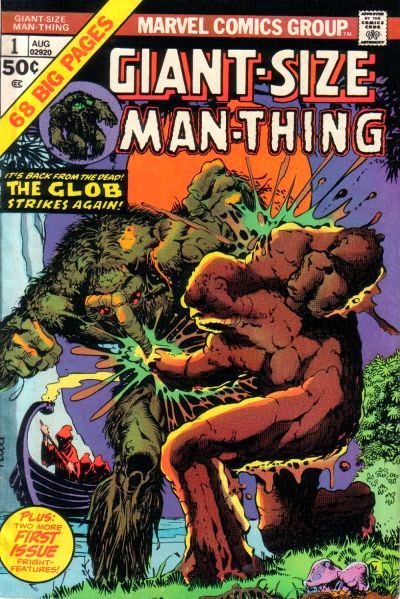
It was a few years before readers once again encountered the Glob. In 1974 he/it returned again, not in the pages of The Incredible Hulk, but in Man-Thing. Or rather Man-Thing's quarterly companion title Giant-Size Man-Thing. No, I'm not saying anything. We've all heard the jokes about that title. 
After his encounter with the Florida based swamp monster, the Glob once again encountered The Hulk in a two part story in Incredible Hulk #197/8 which also featured a guest appearance by Man-Thing.
And then the Glob disappeared. A second Glob popped up in Incredible Hulk #398, but the original vanished, not to be seen again until 2005 when he/it turned up alongside Clone of Frankenstein, Gorilla-Man, Grogg, N'Kantu (The Living Mummy), Nina Price (Vampire By Night), Warwolf, and The Zombie as one of Nick Fury's monstrous Howling Commandos. One final appearance in the pages of She-Hulk, and that's all she wrote for Joe Timms.
Now, the first appearance of The Glob obviously proved popular, hence his rather rapid return eight months later. But was The Glob popular enough for someone at Marvel to think about a regular comic featuring a swamp creature? Who knows, but it wasn't too long before Marvel's more familiar muck monster Man-Thing made his first appearance. And we'll come to him in a couple of weeks. Next week however -- The Heap! Again! 
Before that of course there's another Fourth World Thursday, and a little feature in the works about some of Marvel's short horror stories.
'Til next time,
Steve

Thursday, 10 July 2014

FOURTH WORLD THURSDAY - "THE HUMAN CELL... HAS YIELDED SOME STRANGE DEVELOPMENTS!"

The Saga Of The D.N.Aliens...

SPJO #136 Cover by Neal Adams
Having looked at Kirby's other three Fourth World titles over the past three weeks, it's time to return to the bizarre adventures of Jimmy Olsen. We ended on a cliffhanger, with a clone of 1940s hero the Guardian about to take on the giant, green kryptonite enhanced duplicate of Jimmy created by The Evil Factory. You remember, the one that's already taken out Superman, supposedly the most powerful being on Earth. So how long is the non-superpowered Guardian going to last?
Not that long, actually. About five pages. And that's including a double page spread. So, with the Guardian down, Jimmy rushes in to try to revive The Man Of Steel. BAD move, as he is promptly grabbed by his emerald hued counterpart.
The giant is taken aback when he discovers that he and Jimmy look exactly alike. Well, apart from the green skin, green hair and a whopping great size difference. Supes takes advantage of the hesitation caused by the creature's uncertainty by stomping the floor, causing a mini-tremor that throws the giant off-balance and drop Olsen. At which point there's a blinding flash, a cloud of pink smoke and down goes the not-so-jolly-green-giant.
So what happened?  Unseen by anyone, a miniature clone of Scrapper had parachuted in, landed on the giant clone's head and set off a grenade full of sleeping gas. His job done, a squadron of mini-Scrapper-clones (who will later be called Scrapper Troopers) also parachute in, set up some cryogenic equipment and freeze the sleeping giant with a coat of liquid nitrogen. Which makes him look a bit like another Kirby Kreation, the Silver Surfer. The Newsboy Legion (mark I) rush in, and have the creature taken away for further examination.
Over at the Evil Factory, Simyan and Mokkari are getting castigated by Darkseid for failing in their mission to destroy "The Project". Time to come up with another plan, but first they trot off to look at a giant mock-up of their rival. I guess Simyan or Mokkari REALLY wanted a model railway growing up!
Back at The Project, Superman, Jimmy and the Guardian congratulate themselves on a job well done, despite the fact that all they did was keep the giant busy until the "Scrapper Troopers" arrived to save the day. But then, hey, they're just clones after all. They don't need any credit!
Right, that explains EVERYTHING! I think!


Unusually for a Kirby Komic, for the rest of the issue nothing much happens. The Newsboys (Mark I) tell their offspring about the fate of the original Guardian. Jim Harper was shot in the line of duty, and as he lay dying he revealed to the now adult Newsboys that he had indeed been The Guardian. And they promptly nicked some cell samples and cloned him.
Meanwhile the Man Of Steel gives Jimmy another tour of The Project. More clones - Gabby replicas this time, whose sole purpose seems to be switchboard operators in The Project's communications section. And then even more clones, being brought up in a nursery.  "They belong here, Jimmy! The Project grows its own!" explains the Big Blue Boy Scout. Er, that sounds suspiciously like all The Project is doing is breeding "people" that are just happy to work for nothing. And how are they doing this? Good job Superman has a handy-dandy wall chart to explain everything. Or not!
Now, it appears that there are three types of clones being created at The Project - "Normals", "Step-Ups" (clones with higher intelligence which include The Hairies we saw in earlier instalments) and... "Aliens". Or rather one Alien. The titular D.N. Alien, in fact. A purple/grey dude with yellow horns called Dubblex. Exactly what Dubblex is isn't really explained, other than Superman's rather vague "The human cell has been subjected to a wide range of conditions -- and has yielded some strange developments!"
DUBBLEX - I'm not sure he's happy about being the local talking point!
Dubblex's post at The Project is purportedly a researcher, but seems really to be only there for The Project to show off to visiting dignitaries. “Dubbilex is resigned to being The Projects’ ‘conversation piece!’ He’s seen by every visiting V.I.P.!” says Superman, who is obviously taking Dubblex away from some vital research to show him off to a visiting dignitary... er, cub reporter.
"There was one senator who called me "The Man From Mars!" sighs Dubblex in response.
As the pair leave The Project's resident alien, Superman ponders what their hidden enemy is up to with the cells they have stolen. Good question Supes! Fortunately we readers have one superpower you don't. We can use our super ability of turning the page...

Aha! Mokkari and Simyan have obviously run out of Gamma Rays, because they've been zapping some human cells with "Beta Rays". The result is a batch of giant eggs, one of which is about to hatch, spawning...
Something with four arms. Something we'll see more of next issue...
Coincidence? Marvel's Four-Armed Men!
A quick aside. Here's a strange coincidence - this issue of Jimmy Olsen had a cover date of March 1971. Amongst DC's rival Marvel's comics for that month was "Where Monsters Dwell" #8. And what did this reprint comic have as it's lead story? A Kirby illustrated tale about a race of creatures with four arms called "Look Out!! Here Come... The Four-Armed Men!" originally published in Marvel's "Tales To Astonish" # 26. Most odd! Anyhow, back to the issue in hand.
After the breakneck pace of earlier installments of Jimmy Olsen, this issue just sort of fizzles out. After the initial eight page battle sequence, the rest is primarily exposition. It's still interesting stuff, and an enjoyable read, with Jack throwing concepts at the reader left, right and centre. The art is still prime Kirby, albeit maybe not as detailed as his work on the other Fourth World titles, especially New Gods. It's probably due to Jack putting more effort into his own creations rather than the title he inherited, but even if he didn't have the same enthusiasm for Olsen, he still gives us plenty of Kirby Goodness.
And to this day, Jimmy Olsen is my second favourite of the four Fourth World titles, behind New Gods. Why? Simply because it is so much FUN!
Next time on Fourth World Thursday, it's Super War over in the pages of Forever People.
Before that, there'll be a new Muck Monster Monday, where there shall come a Glob!
See you soon,
Steve


Thursday, 22 May 2014

IT'S FOURTH WORLD FRIDAY!!! (A DAY EARLY!)

My favourite of all of the prodigious output by the late Jack "King" Kirby has always been his meisterwork, the so-called "Fourth World" trilogy (technically a tetralogy). I realised the other day that Kirby was 53 when it started publication for DC Comics, the same age I am now.
Jack's departure from Marvel Comics in 1970 to go to their biggest competitor DC shook the industry. It was if John Lennon had left the Beatles to join The Rolling Stones. Kirby had been one of the lynchpins of Marvel the Lennon to Stan Lee's McCartney (maybe with Steve Ditko in the George Harrison role). 
It was while at Marvel that Kirby came up with the idea of a major epic storyline detailing a great war between two races of gods, with Earth as the battleground.
It has been suggested that Kirby originally intended to set up his new concept in the pages of Thor. Asgard would fall in Ragnarok, and out of the chaos two worlds would form - one of light, one of darkness.
When he left Marvel, he took his new concepts with him. At DC, he planned to tell his story across three new titles, "The New Gods", "The Forever People" and "Mister Miracle" whilst also taking over the already existing title "Superman's Pal, Jimmy Olsen". 
As an aside, Kirby, as always ahead of his time, conceived the notion of serialising the storyline in the comics, later collecting them in book form. Although a familiar concept in European (but not British) comics, it was a whole new way of thinking for the American market. Sadly it never came to fruition. It was another 10-15 years before the idea of the Trade Paperback or Graphic Novel would develop in the US market. In addition, sales on the new titles didn't reach expectations and one by one the series were cancelled, leaving the grand saga unfinished.  Kirby continued at DC, creating Kamandi and the Demon along with other shorter lived series.  But back to The Fourth World...
 It could be said that each of the four books showed the great conflict from a different perspective. "New Gods" showed the seasoned warriors in action, primarily the god Orion. "The Forever People" showed the eager young recruits, not yet scarred by battle. "Mister Miracle" is the conscientious objector. And "Jimmy Olsen" (and also the non-Kirby "Lois Lane" to a lesser extent) tied the book to the rest of the DC Universe and showed some of the effects of the war on Earth. And it was there in the pages of "Superman's, Pal Jimmy Olsen" that we saw the first seeds of Kirby's magnum opus.
So that's where we will start our issue by issue look at "The Fourth World" next time, with "Superman's Pal, Jimmy Olsen" # 133.

Sunday, 24 April 2011

BACK FROM THE DEAD... IN MORE WAYS THAN ONE! (PART ONE)

Well, it's been a while again, but I'm finally hoping to get this blog back on a (semi-)regular track.
As befits the returning from the dead theme, today I'm taking a look at Marvel's classic 1970's Tomb Of Dracula, recently collected in a series of three hardcover omnibus collections. Be warned though, this comes with a bit of a history lesson...

Back in the mid-1950s there was a certain amount of hysteria against comic books. The general perception is that the brunt of the anti-comic movement was aimed at the horror comics, especially those published by William Gaines' EC comics, but in truth there were also complaints about the levels of violence in war and crime comics and about the sexual innuendo in what has become known as 'good girl art'.

The anger against the salacious nature of some of these titles actually led to at least two city councils - Houston, Texas and Oklahoma City - passing ordinances prohibiting the sale of crime and horror comics. Another attempt, by the city council of Los Angeles, failed when it was deemed by the courts to be unconstitutional.

In addition The United States Senate Subcommittee on Juvenile Delinquency, formed in 1953 to investigate the problem of, well, juvenile delinquency, also turned it's attention to the problems of comic books. A defining moment during the subcommittee's public hearings was Bill Gaines attempt to defend his EC comics including this infamous exchange between Gaines and Democrat Senator Estes Kefauver of Tennessee...

Mr. Beaser: Is there any limit you can think of that you would not put in a magazine because you thought a child should not see or read about it?
  • Gaines: My only limits are the bounds of good taste, what I consider good taste.
  • Sen. Kefauver [refering to the cover of EC's Crime SuspenStories #22 -pictured]: This seems to be a man with a bloody ax holding a woman's head up which has been severed from her body. Do you think that is in good taste?
  • Gaines: Yes, sir, I do, for the cover of a horror comic....
  • Sen. Kefauver: This is the July one [Crime SuspenStories #23]. It seems to be a man with a woman in a boat and he is choking her to death with a crowbar. Is that in good taste?
  • Gaines: I think so.

  • The hearings made the front page of the New York Times the next day. The bad press meant that in several publishers were forced to revamp, censor or even cancel many long-running and popular titles.

    It was in response to this anti-comics fervour that the Comics Magazine Association of America was formed in September 1954. Headed by Charles F. Murphy, a noted New York attorney, the CMMA established the Comics Code Authority (CCA), which based its code upon an earlier, but largely unenforced code, which had been drafted in 1948 by the Association Of Comics Magazine Publishers. The Comics Code Authority served as a way for the comics industry to censor itself as opposed to the publishers being Federally regulated.

    The new code banned the depiction of "policemen, judges, government officials, and respected institutions ... in such a way as to create disrespect for established authority" and "in every instance good shall triumph over evil". Excessive violence was forbidden, as were horror staples such as Zombies, Ghouls, Werewolves and... Vampires (see where we're going here?).

    The code stayed in force until 2011, although as time went on many of the restrictions were slowly lifted. On January 28th 1971, the code was revised to allow some leeway in the depiction of criminal behavior. Also newly allowed were "vampires, ghouls and werewolves... when handled in the classic tradition such as Frankenstein, Dracula, and other high calibre literary works written by Edgar Allan Poe, Saki, Conan Doyle, and other respected authors whose works are read in schools around the world". The poor Zombie, however, apparently lacked enough literary merit and thereby remained on the banned list.

    Having nearly gone out of business in 1957 after publisher Martin Goodman made a disasterous decision to switch distributors, Marvel Comics had risen through the 1960s to be a main player in the comics field, due in no small part to writer/editor Stan Lee's new take on the superhero formula. In 1969 the Marvel line consisted primarily of superhero titles alongside a handful of Western titles (Kid Colt Outlaw, Rawhide Kid) and Teen humour/romance titles (Millie The Model, Chili). Added to the line were two horror titles - Tower Of Shadows and Chamber Of Darkness which contained new short horror stories, including adaptatons of tales by writers such as H.P. Lovecraft.

    Another new title, launched in 1970, was Astonishing Tales. An addition to Marvel's burgeoning superhero line, it was a split book featuring two stories, the first starring Marvel's Tarzan knock-off Ka-Zar, the other featuring frequent Fantastic Four protagonist Dr. Doom. While short-lived, the Dr. Doom strip paved the way for many of Marvel's future horror titles by having the concept of having a villainous figure as the star of a comic book. A format that titles such as Tomb of Dracula and Werewolf by Night would take so much further.

    Over in the pages of Marvel's best selling title 'The Amazing Spider-Man' (#101) writers Stan Lee and Roy Thomas introduced Morbius, the so-called 'Living Vampire'. Created by scientific methods rather than supernatural means, Morbius was the first of Marvel's vampire characters. Roy Thomas had originally intended for the protagonist of this story to be Dracula himself, but Lee nixed the idea, probably due to other plans he already had for the character, as can be seen by the announcement made in the Bullpen Bulletins pages in Marvel Comics of July 1971.

    "SAVAGE TALES (our M-rated mag - for the mature reader) looks like such a howlin' hit that we're following it up with a ghoulish 50c goodie called THE TOMB OF DRACULA (or THE HOUSE OF DRACULA, we haven't decided yet). It's a wholly new concept, starring Dracula himself, as he is - was - and perhaps will be. With art by GENE COLAN, BERNI WRIGHTSON and GRAY MORROW among others, and a team of the world's most titanic scripters, headed by Marvel's merry masters SMILIN' STAN and RASCALLY ROY themselves! May we modestly say - it ain't to be missed!"

    Marvel's original concept of a 50 cent black and white magazine fell by the wayside at the last minute and the Tomb Of Dracula made it's belated debut as a regular colour comic with a cover date of April 1972. Ironically, the delays to the title's launch -partly caused by having to have Gene Colan's art reformatted for the smaller page size of the comic book format - meant that Dracula was actually beaten to the newsstand by another of Marvel's horror creations "Werewolf By Night" which debuted in the pages of Marvel Spotlight #2 with a February 1972 cover date.

    The premiere issue of Tomb Of Dracula was scripted by Gerry Conway from a plot by either Stan Lee or Roy Thomas (or possibly both). The cover art was by the legendary Neal Adams, but it was the interior art by the incomparible Gene Colan that gave the title its look. Colan, who had been a stalwart of strips such as Iron Man, Daredevil and had excelled on Doctor Strange, had lobbied to be given the title over Stan Lee's first choice of Sub-Mariner creator Bill Everett. In an interview with Roy Thomas in Alter Ego magazine (Vol. 3, #6) Colan reveals how he got the job...

    COLAN: Yep. The only strip I really begged for was Dracula. He promised it to me, but then he changed his mind, he was going to give it to Bill Everett.
    THOMAS: It's funny, I don't remember Bill being the designated artist, but I'm sure you're right.

    COLAN: Oh, I said to him, "Stan, you gave me your word I could have it!" He said, "No, I'm afraid not, Gene. I actually promised it to Bill before you!" But I didn't take that for a answer. I worked up a page of Dracula, long before Bill did anything. I just sat there, and I inked it, a whole page of the character, just sample drawings of him. I fashioned him after Jack Palance, years before Palance played Dracula on TV, and I sent it in. I got an immediate call back. Stan said, "The strip is yours."
    THOMAS: It probably worked out for the best. Bill was certainly a good artist, but I don't think he'd have gotten what Stan was really looking for in Tomb of Dracula.
    COLAN: I didn't think so. I thought I was the only one for it.
    Conway's script introduced Frank Drake, last living descendent of the Dracula line. Drake travels to Transylvania with his fiancee Jeanie and friend Clifton Graves with a plan to turn the legendary Castle Dracula, which Frank has inherited, into a tourist attraction. However, things don't quite go as planned when, whilst exploring the castle Graves falls through a rotting floor and finds himself in a crypt, complete with a coffin containing a skeleton with a wooden stake in it's chest area. Graves removes the stake thus causing Dracula to rise from his tomb.
    Writer Conway only stayed on the title for one more story before passing the reins to Archie Goodwin with the third issue. Goodwin introduces us to Rachel Van Helsing, descendent of Abraham Van Helsing from Bram Stoker's original novel, and her mute servent Taj. The two eventually encounter Drake and the three combine forces to hunt down Dracula.
    Goodwin also only lasted two issues before handing it over to Gardner N. Fox. Better known for his superhero works at Marvel's main rival DC, Fox had also written for pulp magazines such as Weird Tales. He too only lasted two issues and with Tomb Of Dracula's seventh issue the writing chores were taken over by Marv Wolfman. And it is with Wolfman's arrival the strip really takes off...
    To be continued...