Well it's been a while, hasn't it?
As many of you know, I (and my better half Jackie) have recently relocated from Farnborough to the village of Mapplewell in South Yorkshire. On top of that my lovely daughter Jal recently got married, so most of my time has been taken up with first the move, and then the wedding. Now that both are over, I can finally get back to my irregular blog.
There will be a few changes here over the few weeks. I'm going to introduce Amazon links to items I review, so you can find them easily. I was in two minds whether to do this. On the one hand, any time somebody orders something through Amazon using the links, it generates a little extra income for us, but at the same time I don't want to take sales away from local comic shops for they are the lifeblood of our business. I leave the choice in your hands, but please support your local comic shop (if, indeed, you still have one).
The other change will be the occasional competition on here. Not sure what form they'll take yet, but I'll come up with something...
I'll be back very shortly with the first of my new reviews, so I'll see you all soon.
Steve
Thursday, 12 August 2010

Wednesday, 16 June 2010
LONG LIVE THE KING!

As far as I know, there hasn't been an official announcement from IDW yet, but it appears that there will soon be another collection of Jack Kent's wonderful strip King Aroo. Amazon UK are already listing volume two as available for pre-order, although as yet there's no mention of it on IDW's website. As the first volume is by far my favourite strip collection of recent months, I just cannot wait to get my hands on this new book. Will let you know as and when I have a release date.
UPDATE! Those splendid chaps at IDW have just let me know that we can expect the King's arrival in November. Let your local comic shop know it's coming, and get them to pre-order it for you.
UPDATE! Those splendid chaps at IDW have just let me know that we can expect the King's arrival in November. Let your local comic shop know it's coming, and get them to pre-order it for you.
Monday, 14 June 2010
AL WILLIAMSON (1931-2010) R.I.P.
 Another of the greats has left us. Al Williamson, one of the industry's finest artists, passed away on the 13th June.
Inspired by the work of Alex Raymond, Williamson took art classes with Tarzan artist Burne Hogarth, and later studied at Hogarth's Cartoonists and Illustrators school, where he met fellow future EC artists Roy Krenkle and Wally Wood. After working for publishers such as American Comics Group (ACG), Avon, Fawcett and Standard, Wiliamson started working at the renowned EC Comics. While there he often worked with Frank Frazetta, Angelo Torres and Roy Krenkel in a group affectionately known as the 'Fleagle Gang'. Willamson's talents were put to good use at EC, notably on the science fiction titles Weird Fantasy, Weird Science and Weird Science Fantasy. Working from stories by editor Al Feldstein, as well as adaptations of stories by well known writers such as Ray Bradbury, Williamson provided page after page of detailed, superblative art.
From 1955 to 1957, he also worked for Marvel Comics, then still known as Atlas. He produced many short three to five page stories, including a stint on the Jann Of The Jungle strip.
In the sixties, with work in the comic book field at a low, Al turned to the newspaper strip where he worked as an assistant to John Prentice on the Rip Kirby strip. This would last for three years and certainly proved to be a good training ground for when he himself would work on a strip of his own.
He returned to comics in 1965 doing one stories for Gold Key titles such as Boris Karloff Tales Of Mystery and The Twilight Zone, and also helped launch the B&W horror magazines Creepy and Eerie for Warren Publishing.
1966 proved to be a gre at year for Williamson as he was asked to draw the first issue of a new Flash Gordon comic book series. He returned to aso draw issues 4 and 5 and was awarded the Best Comic Book award by the National Cartoonist Society for his work. In addition, it was on the basis of his work for Flash Gordon that he was offered the chance to work on the Secret Agent X-9 newspaper strip.
Secret Agent Corrigan, as the strip was rechristened, reunited Williamson with writer Archie Goodwin and together the two produced a more than a decade of exciting daily adventure. His art here was at it's peak (sorry EC fans) and is shortly to be collected in a series of collections by IDW publishing.
During this time Wiliamson continued to do comic book work, including more work for The Twilight Zone, Creepy and Eerie as well as tales for DC Comics mystery anthology House Of Mystery. In addition he encouraged young up and coming artists such as Mike Kaluta and Berni Wrightson and helped them break into the comic business.
Al left Secret Agent Corrigan in 1980, he and Goodwin took on the comic book adaptation of The Empire Strikes Back and then turned his hand, again with Goodwin, to the Star Wars newspaper strip until it's cancellation in 1983.
From the mid 1980s onwards Wiliamson had worked primarily as an inker, working with pencilers as diverse as Mike Mignola, John Romita Jr., and Gene Colan. As an inker he won no less than nine industry awards.
His influence on the industry cannot be measured. His artwork alone puts him among the greats, but his encouragement of other artists such as Kaluta and Wrightson, and the fact that he has been cited by many others, including Dave Gibbons, Mark Schultz, Tony Harris and Frank Cho, as an influence elevates his standing in the industry even higher.
Rest In Peace Al.
Wednesday, 26 May 2010
DITKO'S STRANGE WORLD
Up to now, this blog has primarily focused on reprints of newspaper strips. I'm not sure why that is, apart from the number of excellent collections that have come out recently. So today I'm going to look at four recent books featuring the work of the legendary comics artist Steve Ditko. As I've already said in a previous blog entry, I'm a huge fan of Ditko's work, and while he's best known for his work on Spider-Man and Doctor Strange for Marvel (both of whom he co-created), The Creeper for DC and Captain Atom for Charlton there is far more to him than superheroes.
First up is Stranger And Stranger: The World Of Steve Ditko. Unlike the other books here this is not a collection of Ditko's stories, but a work tracing the life and career of one of comics most mysterious creators. The book's author Blake Bell has done an exemplary job of telling the tale of the notoriously reclusive artist, from his early days in the comics industry studying under Jerry Robinson, through his breakthrough with Charlton Comics, the heady days of the early Marvel Bullpen, his departure for DC comics, up to his self-published (with Robin Snyder) Steve Ditko's Packages of the late 1990s. Bell delves into Ditko's fascination with the writings of Ayn Rand and explores how the influance of books like The Fountainhead affected the artists later career and his relationship with comic fandom. Lavishly illustrated with page after page of Ditko art from all stages of his career, and with quotes from many of the people he worked with in the industry this book is a must for anyone with an interest in comics most celebrated and yet unknown artists.
Next, also from Fantagraphics and Blake Bell, is the superb Strange Suspense: The Steve Ditko Archives Vol. 1 which I mentioned in a previous blog entry. This book was compiled by Bell and collects Ditko's earliest work for publishers such as Prize, Gilmor, Ajax/Farrell, Timor and, of course, Charlton. The majority of the stories collected here fall firmly into the horror vein, with tales taken from titles such as The Thing, This Magazine Is Haunted and Strange Suspense Stories. Some science fiction stories are also present from the pages of Space Adventures, while Racket Squad In Action, Crime And Justice and Blazing Western give us... well, crime and western tales. Nearly all of this material predates the introduction of the Comics Code Authority in October 1954, the sole exception being a humour piece Car Show taken from a 1955 issue of From Here To Insanity. This means that much of this material is more visceral than the stories many are familier with from the early 1960s although still tame by todays standards. The reproduction is stunning, showing off Ditko's detailed artwork at its finest. Check out the infamous electric chair cover to Strange Suspense Stories # 19, a detail of which is used as the cover to this collection (see right).
  Or the cover to Space Adventures # 12 with is EC inspired cover (see left). And while the art is all prime Ditko, here and there he does let his influences show through. For example Die Laughing from The Thing #13 has a few layouts and panels inspired by the legendary Will Eisner, while Cinderella from The Thing #12 has a very Mort Meskin feel. This is one of the finest collections of Ditko's work out there, and while it may not be as familier as his work on Spider-Man, Doctor Strange or indeed those mystery shorts he did for Marvel books such as Strange Tales and Amazing Fantasy, it's all classic Ditko. Buy it now, and pre-order volume 2, hopefully due in August this year.
As a quick aside, Ditko's Eisner influance would also show up in his work on Marvel's Doctor Strange strip. The first Dr. Strange story from Strange Tales #110 has some very Eisneresque panels. And that distinct window in the good Doctor's Sanctum Sanatorum bears more than a passing resemblence to the one in Denny Colt's Wildwood Cemetery hideaway. But I digress...
Fantagraphics set the bar high with Strange Suspense, and IDW's The Art Of Ditko collection only just falls short of the other books high standards. Compiled by Craig Yeo for IDWs Yeo Books imprint, this collection concentrates on Ditko's work from the 1960s. With the Comics Code at the height of it's influance the stories here are tamer than those in the Fantagraphics book, while Ditko's artwork is a little less detailed, more akin to his superhero work for Marvel and DC, than his earlier, detailed horror work. Along with numorous examples of Ditko's work from Charlton titles from the sixties, there are reproductions of original art pages from his work with Marvel and DC.
One advantage this collection has over the Fantagraphics volume is that it is oversized, allowing the reader to really appreciate Ditko's stylised art.
While not quite reaching the heights of Strange Suspense, The Art Of Ditko is still an essential purchase for Ditkologists everywhere.
Finally, DC Comics have also brought out a Ditko collection , this one devoted to his work on the superhero strip The Creeper. This volume contains all of the Creeper stories Ditko had a hand in, starting with the characters debut in the pages of DC's tryout comic, Showcase.
For those unfamilier with him, The Creeper was originally introduced in Showcase #73 (1968), which told the tale of outspoken Gotham City talk show host Jack Ryder, gunned down by gangsters when he used his TV show to take a stance against organized crime made him a target. Mortally wounded by the mob, Ryder's life was saved by a scientist who gave him an experimental serum that granted him powers of super-agility. Disguising himself in a bizarre costume, Ryder took on the persona of The Creeper and sought retribution.
After that single tryout issue, The Creeper was quickly given his own title, "Beware The Creeper" the first six issues of which are presented here. Ditko walked off the title having drawn only eleven pages of that sixth issue, with Jack Sparling pitching in to fill out the issue. In fact it looks to me that Sparling may have redrawn those first eleven pages although some of the layouts certainly look like Ditko. The reclusive artist returned to the Creeper in 1975 for another tryout book, First Issue Special #7, and then again in 1978 for a series of backup stories in World's Finest Comics #249-255. All those stories are collected here along with a real treat - a story originally intended for a revival of Showcase but scrapped when that title was suddenley cancelled in the infamous D.C. Imposion of 1978. Instead the story was used in Cancelled Comic Cavalcade, an extremely limited edition collection of material left unpubished, especially compiled by D.C. for copyright reasons. Only a few dozen copies were published, although bootleg copies allegedly exist.
Ditko's art on the earlier Creeper stories is not unlike his later work for Marvel on Spider-Man and Dr. Strange, while his 1970's return to the character exemplifies his looser, simpler style that would also be seen on his later return to Marvel on series such as Machine Man. The stories themselves, written by up and coming talent such as Denny O'Neil and Michael Fleisher are for the main part fairly standard superhero fare, although the earliest stories are slightly more quirky than the standard late 1960s DC superhero title.
All in all, not the most essential of Ditko's work, but certainly well worth a look.
I'll be back soon with more recommendations.
Be seeing you!
First up is Stranger And Stranger: The World Of Steve Ditko. Unlike the other books here this is
 not a collection of Ditko's stories, but a work tracing the life and career of one of comics most mysterious creators. The book's author Blake Bell has done an exemplary job of telling the tale of the notoriously reclusive artist, from his early days in the comics industry studying under Jerry Robinson, through his breakthrough with Charlton Comics, the heady days of the early Marvel Bullpen, his departure for DC comics, up to his self-published (with Robin Snyder) Steve Ditko's Packages of the late 1990s. Bell delves into Ditko's fascination with the writings of Ayn Rand and explores how the influance of books like The Fountainhead affected the artists later career and his relationship with comic fandom. Lavishly illustrated with page after page of Ditko art from all stages of his career, and with quotes from many of the people he worked with in the industry this book is a must for anyone with an interest in comics most celebrated and yet unknown artists.
Next, also from Fantagraphics and Blake Bell, is the superb Strange Suspense: The Steve Ditko Archives Vol. 1 which I mentioned in a previous blog entry. This book was compiled by Bell and collects Ditko's earliest work for publishers such as Prize, Gilmor, Ajax/Farrell, Timor and, of course, Charlton. The majority of the stories collected here fall firmly into the horror vein, with tales taken from titles such as The Thing, This Magazine Is Haunted and Strange Suspense Stories. Some science fiction stories are also present from the pages of Space Adventures, while Racket Squad In Action, Crime And Justice and Blazing Western give us... well, crime and western tales. Nearly all of this material predates the introduction of the Comics Code Authority in October 1954, the sole exception being a humour piece Car Show taken from a 1955 issue of From Here To Insanity.
 This means that much of this material is more visceral than the stories many are familier with from the early 1960s although still tame by todays standards. The reproduction is stunning, showing off Ditko's detailed artwork at its finest. Check out the infamous electric chair cover to Strange Suspense Stories # 19, a detail of which is used as the cover to this collection (see right).
  Or the cover to Space Adventures # 12 with is EC inspired cover (see left). And while the art is all prime Ditko, here and there he does let his influences show through. For example Die Laughing from The Thing #13 has a few layouts and panels inspired by the legendary Will Eisner, while Cinderella from The Thing #12 has a very Mort Meskin feel. This is one of the finest collections of Ditko's work out there, and while it may not be as familier as his work on Spider-Man, Doctor Strange or indeed those mystery shorts he did for Marvel books such as Strange Tales and Amazing Fantasy, it's all classic Ditko. Buy it now, and pre-order volume 2, hopefully due in August this year.
As a quick aside, Ditko's Eisner influance would also show up in his work on Marvel's Doctor Strange strip. The first Dr. Strange story from Strange Tales #110 has some very Eisneresque panels. And that distinct window in the good Doctor's Sanctum Sanatorum bears more than a passing resemblence to the one in Denny Colt's Wildwood Cemetery hideaway. But I digress...
Fantagraphics set the bar high with Strange Suspense, and IDW's The Art Of Ditko collection
 only just falls short of the other books high standards. Compiled by Craig Yeo for IDWs Yeo Books imprint, this collection concentrates on Ditko's work from the 1960s. With the Comics Code at the height of it's influance the stories here are tamer than those in the Fantagraphics book, while Ditko's artwork is a little less detailed, more akin to his superhero work for Marvel and DC, than his earlier, detailed horror work. Along with numorous examples of Ditko's work from Charlton titles from the sixties, there are reproductions of original art pages from his work with Marvel and DC.
One advantage this collection has over the Fantagraphics volume is that it is oversized, allowing the reader to really appreciate Ditko's stylised art.
While not quite reaching the heights of Strange Suspense, The Art Of Ditko is still an essential purchase for Ditkologists everywhere.
Finally, DC Comics have also brought out a Ditko collection
 , this one devoted to his work on the superhero strip The Creeper. This volume contains all of the Creeper stories Ditko had a hand in, starting with the characters debut in the pages of DC's tryout comic, Showcase.
For those unfamilier with him, The Creeper was originally introduced in Showcase #73 (1968), which told the tale of outspoken Gotham City talk show host Jack Ryder, gunned down by gangsters when he used his TV show to take a stance against organized crime made him a target. Mortally wounded by the mob, Ryder's life was saved by a scientist who gave him an experimental serum that granted him powers of super-agility. Disguising himself in a bizarre costume, Ryder took on the persona of The Creeper and sought retribution.
After that single tryout issue, The Creeper was quickly given his own title, "Beware The Creeper" the first six issues of which are presented here. Ditko walked off the title having drawn only eleven pages of that sixth issue, with Jack Sparling pitching in to fill out the issue. In fact it looks to me that Sparling may have redrawn those first eleven pages although some of the layouts certainly look like Ditko. The reclusive artist returned to the Creeper in 1975 for another tryout book, First Issue Special #7, and then again in 1978 for a series of backup stories in World's Finest Comics #249-255. All those stories are collected here along with a real treat - a story originally intended for a revival of Showcase but scrapped when that title was suddenley cancelled in the infamous D.C. Imposion of 1978. Instead the story was used in Cancelled Comic Cavalcade, an extremely limited edition collection of material left unpubished, especially compiled by D.C. for copyright reasons. Only a few dozen copies were published, although bootleg copies allegedly exist.
Ditko's art on the earlier Creeper stories is not unlike his later work for Marvel on Spider-Man and Dr. Strange, while his 1970's return to the character exemplifies his looser, simpler style that would also be seen on his later return to Marvel on series such as Machine Man. The stories themselves, written by up and coming talent such as Denny O'Neil and Michael Fleisher are for the main part fairly standard superhero fare, although the earliest stories are slightly more quirky than the standard late 1960s DC superhero title.
All in all, not the most essential of Ditko's work, but certainly well worth a look.
I'll be back soon with more recommendations.
Be seeing you!
DITKO'S WORLD
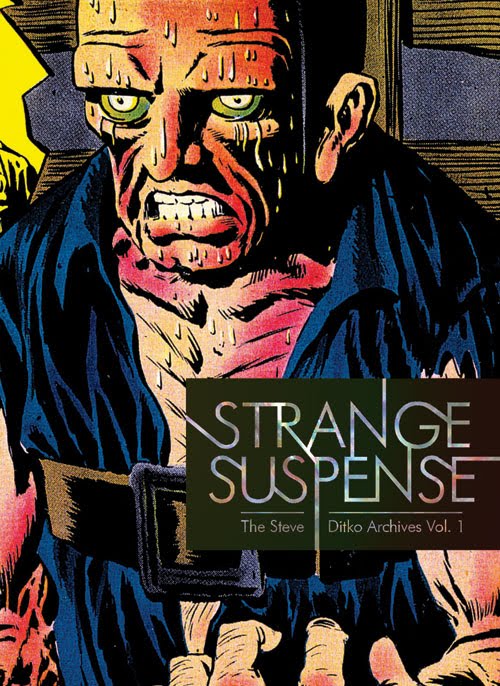
A very quick entry today. Those who know me will know I'm a huge fan of Steve Ditko. A few months ago those wonderful guys at Fantagraphics books published a superb collection of his very earliest comics work called Strange Suspense: The Steve Ditko Archives Vol. 1 (seen here on the right). Now it appears that a second volume called Unexplored Worlds is coming this August. Not sure what it will include, but I for one can't wait. More info as and when I find out. I have a Ditkocentric blog entry coming up soon, including my thoughts on Strange Suspense, so look out for that.
Tuesday, 25 May 2010
COMICS REVUE

Back in the day, before we had all these lovely deluxe hardcover reprints of newspaper strips, we had a number of magazines devoted to strip reprints. Tabloids like The Menomonee Falls Gazette and its sister paper The Menomonee Falls Guardian collected current strips on a weekly basis, while there were other magazine collections devoted to specific strips such as Twin Earths and Steve Canyon. Then, in the mid 1980s, a new monthly magazine entered the market. Comics Review started off reprinting a months worth of current humour strips such as Garfield, B.C., Wizard Of Id, Hagar The Horrible, Tumbleweeds and Bloom County. With its fourth issue many of the humour strips were phased out as adventure strips were added to the mix. Star Wars by the team supreme of Archie Goodwin and Al Williamson, Milton Caniff's Steve Canyon, Spider-Man were all added to the line-up, followed in later issues by Modesty Blaise, The Phantom, Secret Agent Corrigan, Tarzan and Flash Gordon amongst others.
 With the eleventh issue the title changed to Comics Revue and is still running under that name over a quarter of a century on. The format has pretty much stayed the same over that time, although the emphasis shifted gradually away from current strips to vintage reprints, usually from the 1930-60s. Eventually the line up settled down to a range of classic continuity strips. Flash Gordon by Harry Harrison & Dan Barry, Buz Sawyer by Roy Crane, The Phantom by Lee Falk (sometimes alternating with Falk's other classic creation Mandrake The Magician), Secret Agent Corrigan (also by Goodwin & Williamson), Tarzan by Russ Manning, Krazy Kat by George Herriman, Alley Oop by V. T. Hamblin, Little Orphan Annie by Harold Gray, Rick O'Shay by Stan Lynde and Casey Ruggles by Warren Tufts. A veritable cornicopia (or should that be comicopia?) of classic strips.
 Last year saw a major change to the magazine as Diamond Comics Distributors, who supply the title to comics shops, made a number of changes to their minimum order requirements. In order to meet Diamond's new order levels, publisher Rick Norwood took the title down to a bi-monthly schedule but at double the size. Now priced at $16 US, the magazine now boasts more colour pages and better quality paper, which in turn leads to much better reproduction. The extra colour pages enable Rick to run more Sunday page strips, which he is currently using to run the Mandrake story "Doorway To Z" and the classic Phantom tale "Return Of The Sky Band". In addition some strips such as Steve Canyon and Gasoline Alley now have their Sunday strips in colour as well, whereas in earlier issues they were run in black and white.
This new look is an improvement on what was an already fine magazine. I hope the higher price point doesn't deter the magazine's loyal readers. As far as this reader's concerned the new style is a winner. If you have any interest in vintage strips, you owe it to yourself to check out an issue.
Sadly, not many comic shops get in copies for the shelf, so you may have to ask your local store to order one in for you. Do yourself a favour and do it. Trust me, you won't be disappointed.
 With the eleventh issue the title changed to Comics Revue and is still running under that name over a quarter of a century on. The format has pretty much stayed the same over that time, although the emphasis shifted gradually away from current strips to vintage reprints, usually from the 1930-60s. Eventually the line up settled down to a range of classic continuity strips. Flash Gordon by Harry Harrison & Dan Barry, Buz Sawyer by Roy Crane, The Phantom by Lee Falk (sometimes alternating with Falk's other classic creation Mandrake The Magician), Secret Agent Corrigan (also by Goodwin & Williamson), Tarzan by Russ Manning, Krazy Kat by George Herriman, Alley Oop by V. T. Hamblin, Little Orphan Annie by Harold Gray, Rick O'Shay by Stan Lynde and Casey Ruggles by Warren Tufts. A veritable cornicopia (or should that be comicopia?) of classic strips.
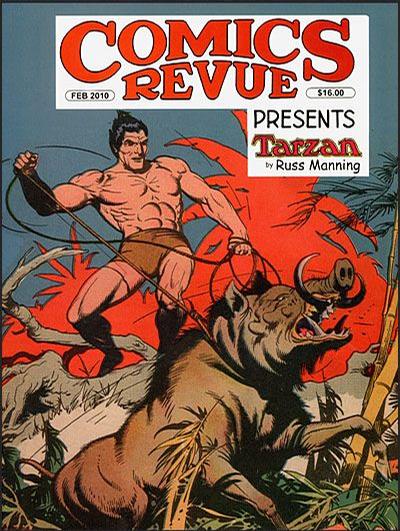 Last year saw a major change to the magazine as Diamond Comics Distributors, who supply the title to comics shops, made a number of changes to their minimum order requirements. In order to meet Diamond's new order levels, publisher Rick Norwood took the title down to a bi-monthly schedule but at double the size. Now priced at $16 US, the magazine now boasts more colour pages and better quality paper, which in turn leads to much better reproduction. The extra colour pages enable Rick to run more Sunday page strips, which he is currently using to run the Mandrake story "Doorway To Z" and the classic Phantom tale "Return Of The Sky Band". In addition some strips such as Steve Canyon and Gasoline Alley now have their Sunday strips in colour as well, whereas in earlier issues they were run in black and white.
 This new look is an improvement on what was an already fine magazine. I hope the higher price point doesn't deter the magazine's loyal readers. As far as this reader's concerned the new style is a winner. If you have any interest in vintage strips, you owe it to yourself to check out an issue.
Sadly, not many comic shops get in copies for the shelf, so you may have to ask your local store to order one in for you. Do yourself a favour and do it. Trust me, you won't be disappointed.
Thursday, 6 May 2010
SECRET AGENT MAN
 I hadn't intended to blog twice in one day, but having just put up the second and final part of my Jeff Hawke review I get news of another strip collection I've been dreaming of! Archie Goodwin and Al Williamson's run on Secret Agent X-9 (later Secret Agent Corrigan) is getting the deluxe hardcover treatment by IDW Publishing as part of their Library of American Comics series. I'm going to let IDW's press release do the talking for me...
 San Diego, CA (May 5, 2010) - IDW Publishing announced today a new hardcover series from its Library of American Comics imprint - X-9: Secret Agent Corrigan. Drawn by Al Williamson and written by Archie GoodwinSecret Agent CorriganAl Williamson's personal proofs in an oversized format that matches IDW's exquisite Rip Kirby series by Alex Raymond. The first volume features an introduction by Mark Schultz, and an essay on X-9's long history by Bruce Canwell. from 1967 through 1980, is one of the classics of modern adventure newspaper comics.The multi-book series is the first-ever comprehensive collection of the strip and will be printed from
"Al Williamson's delicate line-work, coupled with a style that's both realistic and atmospheric, enhances the no-nonsense story of the sophisticated action hero Phil Corrigan," said series editor Scott Dunbier. Dean Mullaney, series designer and the Library of American Comics Creative Director, added, "Archie Goodwin's unerring sense of pacing, which he developed in comic books, is even more noticeable in the daily strip format."
Secret Agent Corrigan updates the character created in 1934 by Dashiell Hammett (The Maltese Falcon) and Alex Raymond (Rip Kirby). X-9 was originally an agent known only by his code name, who worked for an unknown government agency. Over the years, the series benefited from the individual styles of many writers and artists - including Leslie CharterisThe Saint novels), Charles Flanders, Mel Graff, Bob Lubbers, and George Evans - but it is the Goodwin/Williamson tenure that is most fondly remembered by today's comics fans. It was during their run that X-9 received the name of Phil Corrigan. (author of
Secret Agent X9, Volume One ($49.99, 296 pages) debuts in July 2010. Diamond order code MAY10 0403. ISBN 978-1-60010-677-2.
 Regular readers (should I have any) will know that on this very blog I recently wrote about IDW's wonderful collection of Jack Kent's King Aroo strip. If this Secret Agent Corrigan collection is as good it'll be one of the best collections of 2010. I'll let you all know in July how it looks. Somehow, I don't think I'll be disappointed!
Wednesday, 5 May 2010
FLIGHT OF THE HAWKE (Part Two)
 The second of Titan's hardcover collections of Jeff Hawke collects another five stories of the British space ace, starting with the time-bending 'Pastmaster' and running through to the whimsical 'A Test Case'. Again all the stories are written by Willie Patterson and beautifully illustrated by Sydney Jordon. These are stories #18 to 22 and comprise the strips from 3rd August 1961 to 2nd January 1963.
The first story 'Pastmaster' relies on the old, familiar idea of someone from the future trying to change the past. Patterson's script and Jordan's art lift this story of the future (or non-future) of Earth's first manned Lunar base above the science-fiction cliche.
Next up is one of Jordon's personal favourites, 'The Immortal Toys'. Once again relics from the distant past show up in the present day ala Volume One's 'Wondrous Lamp'. This story includes some of Jordon's finest art, inspired by Patterson's imaginative story.

Story three is the humorous 'The Ambassadors' in which Earth is visited by two avian emissaries from another world. When the owl-like aliens appear on TV promising to abolish work with a device called a 'quiggifier' people start to take notice, until an unfortunate accident results in the two birds leaving the Earth for good.
Another science-fiction stand by, the sub-atomic world, is used in the next story 'The Gamesman' in which Hawke and Mac find themselves transported to another world, where they are hunted by an alien overlord. Very reminiscent of 'The Most Dangerous Game'. A slight twist here is that it is EARTH that is the sub-atomic planet, existing in a piece of amber on the alien world.
The fifth and final story is 'A Test Case', in which some bumbling alien students arrive on Earth and try to impart some of their knowledge to the 'backward' planet. Unfortunately their first test subject has his own ideas on what to do with the alien knowledge, and it isn't necessarily what is best for the rest of the world. One minor flaw with this story is that the aliens look like various earth animals (the students teacher is elephantine for example) which would be fine, but maybe a bit too soon after the owl-like aliens of 'The Ambassadors'. Still, a whimsical story, with a race against time to save the world ending.
Sadly, this is the last of Titan's collections to date. Between the two books only nine of the sixty-nine Hawke stories have been reprinted. Hopefully more volumes will follow. In the meantime the Jeff Hawke Club have been reprinting more stories in their magazine 'Jeff Hawke's Cosmos'.
More details of the Jeff Hawke Club can be found on their website at http://www.jeffhawke.com/
FLIGHT OF THE HAWKE (Part One)
 We now return to our regular schedule...
 There's been a fine tradition of Science Fiction continuity strips in the newspapers. America has given us Buck Rogers, Connie (of which more of in a forthcoming blog), Twin Earths, Star Hawks, Brick Bradford and of course Flash Gordon. Over this side of the pond there have been the long running Garth in the Daily Mirror and the much shorter running Scarth A.D. 2195 in The Sun. Even Mega-City One's top lawman Judge Dredd crossed the Cursed Earth to the tabloid pages. Quite possibly the best of the British strips has been Jeff Hawke. Created and illustrated by Scotsman Sydney Jordon for The Daily Express, the early storylines were fairly run of the mill, featuring the eponymous hero, an ex R.A.F. pilot (as indeed was Jordan), in a series of ordinary science fiction adventures. The arrival of Jordan's childhood friend Willlie Patterson as co-writer took the strip to a new level. Patterson dialogued the sixth storyline 'Sanctuary' (1956) and plotted and wrote the seventh 'Unquiet Island' (1956/7). Jordon then wrote the eighth story with the ninth 'Out Of Touch' being written by famed SF author Harry Harrison, creator of the Stainless Steel Rat and occasional contributor to the American Flash Gordon strip. A few more Jordon written stories followed and then, in 1960, Patterson took on the full writing duties with the fourteenth story "Overlord".
It is this story that leads off the first of two recent hardcover collections from Titan. Hawke and his team have their second encounter with the meglomaniacal Chalcedon (introduced a few years beforehand in the story Sanctuary) and a race of telepathic beetles.
The very nature of humanity is the theme of the second story, Survival, which opens with a collision in space in which Hawke's right hand man Mac MaClean is severely injured. The alien race that inadvertantly caused the accident save Mac's life but in doing so 'improve' the astronaut, pushing him further along mankind's evolutionary path. As Mac becomes more superhuman, he also becomes less than human.
A story trope that appears regularly in the series is that of the myth that has a basis in alien technology. Such is the case with the third story The Wondrous Lamp. As may be guessed by its title, it shows the origins of the Aladdin myth. An absolute delight of a story which opens in the 2nd Century and ends in the present with an attempted alien invasion.
As good as The Wondrous Lamp is, the best is saved for last. The fourth and final story in this volume, Counsel For The Defence, sees the return of Chalcedon as Hawke is called upon to act as his defence in a galactic trial before becoming involved in the alien's escape attempt.

Patterson's scripts throughout this book sparkle with wit and whimsy, while Jordan's artwork is wonderful, in a realistic black and white style. It's easy to see why famed comic artists such as Dave Gibbons and Brian Bolland are huge fans of the strip. Curiously Jeff Hawke is largely unknown in his home country, but feted by European comic fans especially in Italy and Scandinavia.
This marvelous hardcover volume also includes the first chapter of a two part essay by Sydney Jordon about his early life, and each of the four stories also includes a brief introduction by the artist. Add to that a gorgeous colour cover by Brian Bolland and you have the perfect introduction to a sadly neglected British classic.
Stay tuned for my thoughts on volume two - The Ambassadors.
Tuesday, 4 May 2010
PETER O'DONNELL (1920-2010) R.I.P.

Planned to Blog today about the SF strip Jeff Hawke, but there has been, as they say, a change to the scheduled programming...
One of the greats has left us. Peter O’Donnell died last night, just a week after celebrating his ninetieth birthday.
He worked on such strips as Garth and Romeo Jones, but he’s best known for creating the classic Modesty Blaise with artist Jim Holdaway. Starting in 1963 in the London Evening Standard, the adventure strip ran for the better part of forty years covering 96 stories. In addition to the comic strip, O'Donnell wrote eleven novels and two collections of short stories based on the character.
Helped by the wonderful art of Jim Holdaway, Enrique Romero, Neville Colvin and Patrick Wright, O'Donnell took his femme fatale and her faithful right hand man Willie Garvin, through numorous exotic adventures, the like of which are now sadly missing from the newspaper pages.
Rest in peace Peter. You'll be sadly missed.

Subscribe to:
Posts (Atom)